Transformer Turns Ratio Tester: What a TTR Test Tells You
A transformer ratio tester checks winding ratio, vector group and tap position, helping confirm that a transformer matches its nameplate before installation or after maintenance. Wrindu supplies portable and bench-oriented ratio testers for field and factory use.
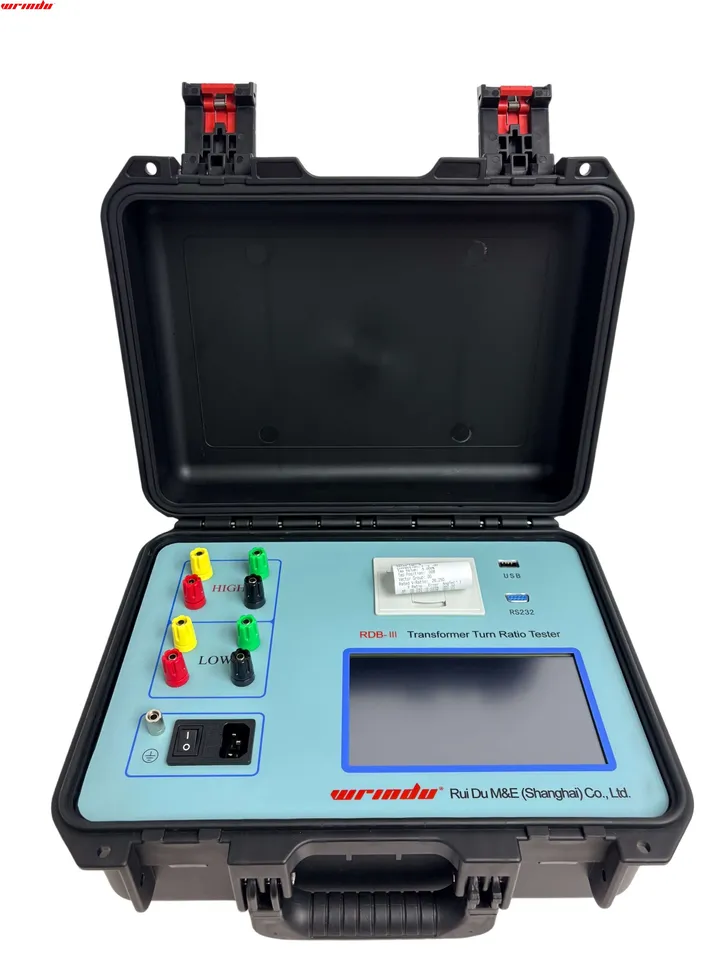
What a Transformer Turns Ratio Tester Measures and Where It Is Used
A transformer turns ratio tester measures the ratio between the high-voltage and low-voltage windings and the vector group. Wrindu supplies ratio testers for use during transformer manufacturing, installation and maintenance, where the test confirms that the winding ratio matches the nameplate and checks tap-changer positions. The same instrument family is also used for PT and CT ratio and polarity testing.
Wrindu offers the RDB-IIHX Portable Transformer Turn Ratio Tester, a compact handheld instrument with simple operation and easy portability, and the RDB-III Transformer Ratio Tester Meter, which measures transformer turns ratio and voltage ratio during manufacturing, installation and maintenance. Both models sit within the transformer test equipment range, alongside dielectric loss and insulation testers used in wider transformer checks.
For a maintenance team, a ratio tester is an initial check before more time-consuming insulation or oil tests. It can be used at incoming inspection, after repair and during periodic maintenance. The result tells the team whether the transformer’s winding relationship is close to its documented configuration before further tests are scheduled.
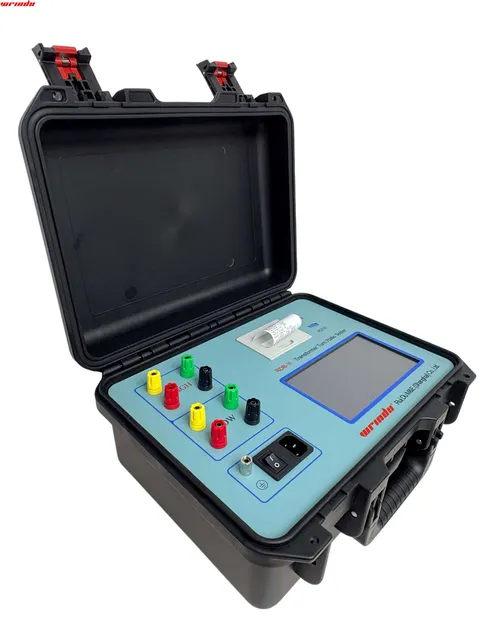
Transformer turns ratio tester, view 2 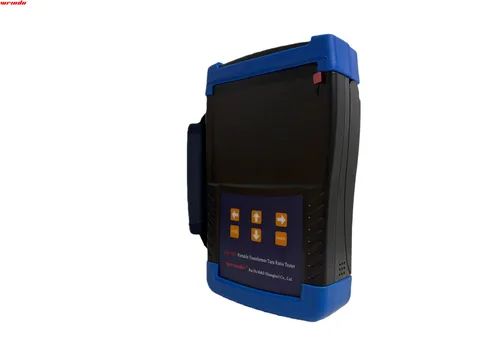
Transformer turns ratio tester, view 3
Transformer turns ratio tester models and specifications
| Parameter | Value |
|---|---|
| Parameter | Specification |
| Test Range | Variable ratio: 0.9–10000; Angle: 0–360° |
| Ratio Accuracy | ±0.1% + 2 digits (0.9–500)±0.2% + 2 digits (501–2000)±0.5% + 2 digits (2001–10000) |
| Angle Accuracy | ±0.2° |
| Resolution | Minimum ratio: 0.0001Angle: 0.01° |
| Output Voltage | Automatically adjusted according to load conditions |
| Power Supply | AC 220V ±10%, 50 ±1Hz |
| Ambient Temperature | -10℃ to 40℃ |
| Relative Humidity | ≤85%, non-condensing |
| Overall Dimensions | Main unit: 360 × 290 × 170 mmCable box: 360 × 290 × 170 mm |
| Weight | Main unit: 5 kgCable box: 5.5 kg |
| Parameter | Value |
|---|---|
| Item | Description |
| Measurement range | 0.9 ~ 10000 |
| Accuracy | ±(0.1%rdg+2dgt) @0.9 ~ 500 ±(0.2%rdg+2dgt) @500.01 ~ 3000 ±(0.3%rdg+2dgt) @3000.1 ~ 10000 |
| Display | 5.6-inch industrial grade high brightness color LCD screen |
| Port | RS232, charging, USB |
| Protection functions | Reverse connection protection, output short circuit protection, etc. |
| Power supply | Rechargeable lithium batteries; Charger input 100-240VAC, 50Hz/60Hz. The charging time is about 2 hours, and the usage time is more than 8 hours. |
| Operating conditions | Temperature -10 ~ 50℃; Relative humidity<90%, no condensation. |
| Parameter | Value |
|---|---|
| Picture | |
| Model | RDB-IIH |
| Test Range | 0.9~10000 |
| Measurement Accuracy | ±0.1% + 2 digits (0.9 ~ 500) |
| Measurement Accuracy | ±0.2% + 2 digits (501 ~ 2000) |
| Measurement Accuracy | ±0.5% + 2 digits (2001 ~ 10000) |
| Resolution | Minimum 0.0001 |
| Output Voltage | Automatically adjusted according to the load |
| Power Supply | Built-in rechargeable lithium battery or power adapter |
| Ambient Temperature | -10℃ ~ 40℃ |
| Relative Humidity | ≤85%, no condensation |
| Model | RDB-II | RDB-Ⅲ |
|---|---|---|
| Test Range | 0.9~10000 | Vriable ratio 0.9~10000, angle 0~360° |
| Angle Accuracy | ±0.2° | |
| Resolution | Minimum 0.0001 | Minimum ratio 0.0001, angle 0.01° |
| Weight | Main engine 5.9kg | Main engine 5kg |
| Weight | Line box 5.7kg | Line box 5.5kg |
| Measurement Accuracy | ±0.1% + 2 digits (0.9~500) | |
| Measurement Accuracy | ±0.2% + 2 digits (501~2000) | |
| Measurement Accuracy | ±0.5% + 2 digits (2001~10000) | |
| Output Voltage | Automatically adjusted according to the load | |
| Working Power Supply | AC220V±10%, 50±1Hz | |
| Ambient Temperature | -10℃~40℃ | |
| Relative Humidity | ≤85%, no condensation | |
| Overall Dimension | Host 360*290*170 (mm) | |
| Overall Dimension | Line box 360*290*170 (mm) |
What a TTR Test Checks on a Transformer
A TTR test applies a low-voltage AC excitation to a winding and measures the induced voltage on the other winding. The resulting ratio is compared with the nameplate ratio. Because the test is made at low voltage, it gives a quick view of the magnetic and winding relationship without energizing the transformer at operating voltage. The operator uses the tester’s wiring scheme for the winding arrangement under test.
The result reveals shorted or open turns, incorrect tap positions, winding connection mistakes and core or winding problems. It sits among the conventional transformer checks that include magnetizing current, winding resistance, short circuit impedance and ratio measurement. When ratio values are read with those checks, a deviation can be traced to a tap setting, a connection error or a winding fault rather than treated as an isolated result.
On site, isolate and discharge the transformer, then record its nameplate data. Identify the HV and LV terminals for each phase and connect the test leads according to the tester’s wiring scheme for single-phase or three-phase measurement. Record the ratio at every tap position, compare each measured ratio with the nameplate value and with the other phases, and repeat the process for each phase before restoring the transformer. Follow the wiring instructions supplied with the instrument.
Choosing a Turns Ratio Tester for Field or Factory Work
Buyers choose a turns ratio tester by matching it to the work. A key decision is single-phase versus three-phase measurement, followed by the tap-changer and ratio range to be covered. Portability matters for substation work, while bench use in a transformer factory may favor a different format. Display and data handling, including printing and export, affect record keeping, and operator skill level determines how much guidance the interface should provide.
The RDB-IIHX Portable Transformer Turn Ratio Tester is a handheld device with compact design, simple operation and easy portability, making it suited to field work.The RDB-III Transformer Ratio Tester Meter covers transformer turns ratio and voltage ratio measurement during manufacturing, installation and maintenance. Model specifications are shown in the specification tables on this page.
Data handling is part of the choice.Teams that work across many tap positions benefit from a clear display and a repeatable way to store readings.
To receive a quotation, describe the transformers to be tested, the winding arrangement, the tap-changer type and the tests needed through the inquiry form or sales email. Wrindu can then propose a suitable model and confirm the delivery route. During the 12-month warranty, Wrindu provides free training, manuals, complaint response and software upgrades; after warranty, maintenance and spare parts remain available.
Practical Limits of a Ratio Test
A ratio test checks winding relationship, not insulation condition. It does not replace insulation resistance, dielectric loss, oil testing or withstand voltage checks. Ratio results are most useful when read with those tests: a ratio deviation points to connections, tap settings or turns, while insulation results show whether the unit can safely withstand voltage. Read ratio results alongside oil testing and dielectric loss testing records.
The ratio test also depends on correct lead connection and stable excitation. If a result is unexpected, check the tap position, the phase identified in the record and the test lead placement before opening the transformer. A repeat measurement made with the specified wiring scheme comes before physical inspection; open the transformer only when the deviation remains.
Request a quotation
Share the equipment under test and the tests you plan to run.
Or write to sales@hipottestequipment.com