Partial Discharge Test Equipment: A Practical Guide for Buyers
Partial discharge test equipment detects localized insulation defects before they develop into failures. This guide explains the main PD test methods, where online and offline testing fit, and which Wrindu instruments suit each test object.
The Main Types of Partial Discharge Test Equipment
Partial discharge test equipment is any instrument used to detect, measure and record partial discharge activity in high voltage insulation. The main types are PD test sets built into an AC withstand voltage system, handheld detectors used for on-site scanning, and fixed monitors that watch a single asset over time. Some units accept several sensor types; others are built around a single application such as cable or switchgear testing.
- RDPDZ-104H: continuous online monitoring of high voltage equipment
- PD Scan: an on-line PD handheld scanner for detecting defects in MV and HV systems
- PD Surveyor: a handheld device that detects PD activity in MV power cables
Wrindu’s handheld PD detector for high-voltage equipment features TEV, AE, UHF and HFCT methods, covering acoustic, electromagnetic and high frequency current signals at the asset. Wrindu is the brand of Rui Du Mechanical and Electrical (Shanghai) Co., Ltd., established in 2014, with over 10 years of export service and deliveries to more than 120 countries. PD instruments sit alongside HIPOT testers and transformer test equipment in the range.
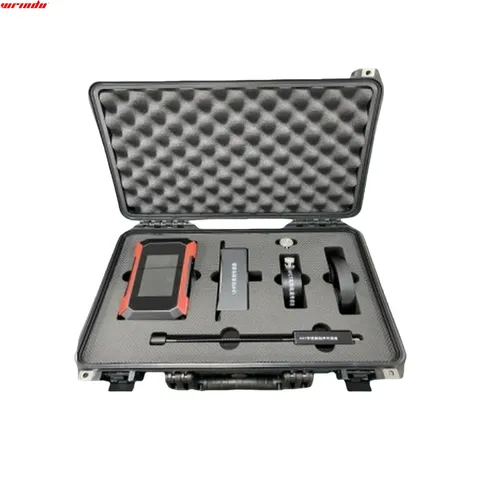
Partial discharge tester, view 2 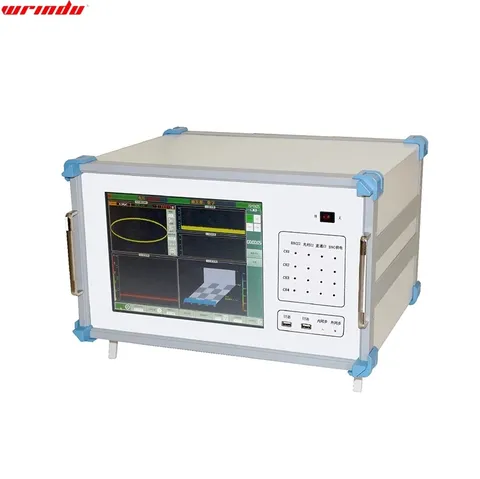
Partial discharge tester, view 3
Partial discharge test equipment models and specifications
| Parameter | Value |
|---|---|
| Picture | |
| Model | RDPDD-104H |
| Technical characteristics | Technical characteristics |
| Number of interfaces | Free-running 4 interfaces |
| Sampling rate | 1M. 5M. 10M selected |
| Sampling accuracy | 12bit |
| Range changing | -40dB, -20dB, 0dB, 20dB, 40dB, 60dB, total 6 types |
| Measurement frequency range | 3dB bandwidth 10kHz~1MHz |
| Digital filtering | 10kHz ~ 1MHz freely selected |
| Program controlled filter subsection | Low frequency: 10kHz, 20kHz, 40kHz, 80kHz High frequency: 100kHz, 200kHz, 300kHz, 400kHz |
| Nonlinear error in the range | 10% |
| Measurement range | 0.1pC ~ 100,000 pC |
| Sensibility | 0.1pC |
| The capacitance range of the measured product | 6pF ~ 250µF |
| Frequency range of test power | 50 ~ 500Hz |
| Display | Display |
| Display screen | 12″ TFT true color touchable LCD screen |
| Resolution | 1024×768 |
| Interface | Interface |
| USB | 3 types, use of external mouse, keyboard, or other USB devices. |
| Power supply | AC 230V; Frequency 50Hz; Power 300W |
| Electric signal interface | 4 BNC interfaces, use of signal input. |
| Optical signal interface | 4 types, use of signal input |
| Network interface | 1 type |
| Landing button | External landing |
| General instruction | General instruction |
| CPU | Basic frequency 1.60GHz |
| Ram | 2.0GB |
| Hard disk | 128GB SSD |
| System | Windows XP |
| Operating environment | Environment ambient: -10 ~ 45℃ ; Humidity: ≤95%RH |
| Dimensions | Length×width×height: 474mm × 288mm × 370mm |
| Weight | 15.8kg |
| No. | Equipment Name | Model / Specification | Quantity |
|---|---|---|---|
| 1 | Power Frequency Partial Discharge-Free Test Transformer | RDYDTW-30kVA/100kV | 1 set |
| 2 | Isolation Transformer | GLB-30/0.38/0.38 | 1 set |
| 3 | Column Voltage Regulator | TEDGC-30/0.38/0~0.42 | 1 set |
| 4 | Capacitive Voltage Divider & Coupling Capacitor | TAWF-100/400 | 1 set |
| 5 | Power Frequency Protective Resistor | GR100-0.3/5 | 1 piece |
| 6 | Control Unit | AC-2020 | 1 set |
| 7 | Noise Filter | LBQ-30/0.4 | 1 set |
| 8 | Triple Frequency Generator | SBP-30/0.38/0.4 | 1 set |
| 9 | Partial Discharge Detector | — | 1 set |
| 10 | Cables and Accessories | — | 1 set |
| Parameter | Value |
|---|---|
| Item | Specification |
| Model | GLB-30/0.38/0.38 |
| Structure Type | Metal enclosure, dry-type |
| Phase | Single-phase |
| Rated Frequency | 50 Hz |
| Rated Capacity | 30 kVA |
| Input Voltage | 380 V |
| Input Current | 79 A |
| Output Voltage | 380 V |
| Output Current | 79 A |
| Waveform Distortion | ≤3% |
| Cooling Method | Natural air cooling |
| Parameter | Value |
|---|---|
| Item | Specification |
| Model | TEDGC-30/0.38/0~0.42 |
| Phase | Single-phase |
| Frequency | 50 Hz |
| Capacity | 30 kVA |
| Input Voltage | 0.38 kV |
| Input Current | 79 A |
| Output Voltage | 0~0.42 kV |
| Output Current | 71.4 A |
| Waveform Distortion | ≤3% |
| Initial Voltage | ≤3% |
| Parameter | Value |
|---|---|
| Item | Specification |
| Model | TAWF-100/400 |
| Frequency | 50 Hz |
| Capacitance | 400 pF |
| Rated Voltage | 100 kV |
| Voltage Ratio | 1000:1 |
| Measurement Error | ≤0.5% |
| PD Level | ≤2 pC @ 100% voltage |
| Withstand Voltage | 110 kV / 1 min |
| Structure | Oil-paper capacitive, insulated enclosure |
| Function | Voltage divider + coupling capacitor |
| Parameter | Value |
|---|---|
| Item | Specification |
| Model | GR100-0.3/5 |
| Rated Voltage | 100 kV |
| Rated Current | 0.3 A |
| Resistance | 5 kΩ |
| PD Level | ≤2 pC |
| Structure | Epoxy cylinder, nichrome wire wound |
| Features | Anti-discharge, shielding rings included |
What Is a Partial Discharge Test?
Partial discharge is a localized electrical discharge that does not bridge the insulation between electrodes. It begins in a void inside solid insulation, at a sharp electrode point, along a contaminated surface or in a gas bubble in oil, and each event transfers only a small amount of charge. A partial discharge test applies voltage to the insulation, or listens to equipment that is already energized, and detects those events as current pulses, acoustic signals or electromagnetic emissions.
Utilities and contractors test for partial discharge because insulation rarely fails without warning. Discharge activity erodes the material around it, so a defect that starts small can grow into a flashover. A PD test looks at the magnitude of the pulses, how often they repeat, where they fall in the voltage cycle, and how the pattern changes as voltage rises and falls. Together these separate a harmless artefact from a defect that needs attention.
Online Partial Discharge Testing: What It Monitors
Online partial discharge testing measures discharge while equipment stays energized at its normal operating voltage. No outage is required and no separate high voltage source is connected, so the insulation is judged under conditions closer to service than a factory test can reproduce. Periodic scanning and continuous monitoring are the common roles: a technician surveys assets with a handheld instrument and compares readings between visits, or fixed sensors record how a single asset develops over time.
Wrindu supplies instruments for both. The RDPDZ-104H handles continuous online monitoring of high voltage equipment, so readings accumulate without a site visit. PD Scan is an on-line PD handheld scanner for detecting defects in MV and HV systems, which suits survey work across a number of assets and locations.
Partial Discharge Cable Testing: What It Finds
Cable PD testing looks for insulation defects and discharge activity in MV and HV cables, most often at joints, terminations and any point where moisture or mechanical damage has weakened the insulation. In service, discharge is picked up with a high frequency current transformer clamped around the screen or ground connection, with electromagnetic or acoustic sensors, or at a joint bay during a survey. During a factory or after-repair test, PD measurement is combined with a voltage withstand test using AC or VLF output, depending on the cable type.
PD Surveyor is Wrindu’s handheld device that detects PD activity in MV power cables. It belongs to the portable side of this work: a technician walks the route, checks joints and terminations, and records what the instrument reports. Cable readings are judged against the cable’s own history and against comparable circuits, since a joint behaving like its neighbours is less concerning than one that stands out.
Partial Discharge Testing of Transformers
Transformer partial discharge indicates a defect in the insulation system, or ageing that has begun to break it down: a void in pressboard, a loose clamping structure, a particle in the oil, or moisture that has entered. PD measurements support diagnosis because magnitude, repetition rate and phase-resolved pattern differ between defect types, and because a rising trend over repeat tests points to insulation that is deteriorating.
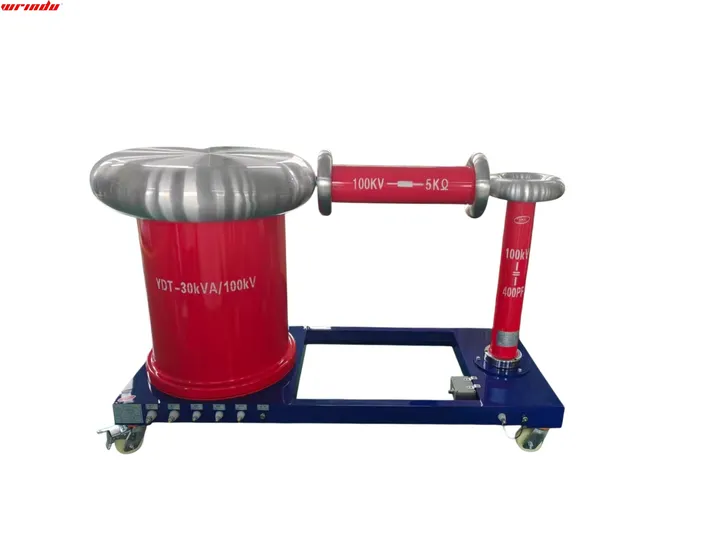
A partial discharge test of a transformer is carried out with voltage applied to the windings: induced voltage during a factory routine test, at commissioning after assembly and oil filling, or during service checks. Where withstand voltage and PD measurement are needed in a single setup, the RDYDTW-30kVA/100kV is a Wrindu withstand voltage and partial discharge test device. Dielectric withstand testing covers the voltage side of that setup.
For transformers that stay in service, the RDPDZ-104H provides continuous online monitoring of high voltage equipment, so discharge activity on the unit can be followed over time.
Matching PD Equipment to the Test Object
Selection starts with the test object and its insulation: a GIS compartment, an oil-filled transformer and a cable joint need different sensors and different test conditions. Decide whether the measurement happens during a withstand test, during a periodic survey or under continuous monitoring, check that sensors can be reached at the asset, and agree how readings will be recorded and compared.
- Send the test object, voltage level and tests needed
- Wrindu proposes a selection for the application
- Order placed, then pre-delivery inspection and packing
- Shipping on FOB terms (nearest port: Shanghai) or by express delivery
- Training and manuals for the operating team
During the 12-month warranty, Wrindu provides free training, manuals, complaint response and software upgrades. The after-sales team offers installation, training and maintenance support, and maintenance and spare parts remain available after the warranty. Many Wrindu listings on its Alibaba store show a minimum order of 1 set; payment is by T/T or PayPal in USD or CNY, and OEM and ODM customized products are available. Contact Wrindu with the asset details.
Request a quotation
Share the equipment under test and the tests you plan to run.
Or write to sales@hipottestequipment.com