Series Resonant Test System: Working Principle, Tests and Selection
A series resonant test system applies AC withstand voltage to cables, switchgear and substations with a fraction of the supply power a conventional test transformer needs. This guide explains the working principle, the tests it serves and the points to specify.
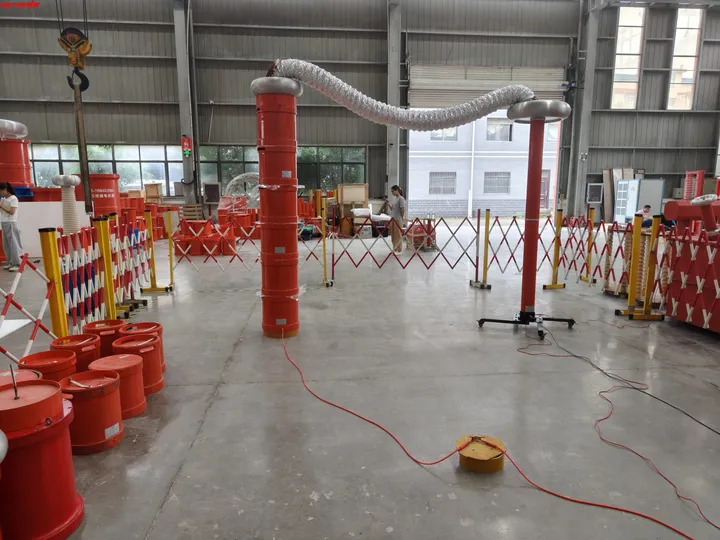
Choosing a Series Resonant Test System for Substations, Cables and Switchgear
A series resonant test system is an AC test set built around a reactor that resonates with the capacitance of the test object. It is used for AC withstand testing of cables, switchgear, transformers and other high-voltage insulation, and its output can feed a partial discharge measurement on the same circuit. Because the reactor and the load capacitance form a resonant circuit, the set reaches the test voltage with a supply far smaller than the test power itself. Wrindu supplies these systems for substation, cable and switchgear testing.
Selection rests on the highest test voltage the object needs, the capacitance range of the objects you will test, and the frequency range the set must cover. Test voltage and load capacitance together fix the current the reactor carries, and therefore its size, weight and number of sections. The frequency range matters because the resonant point shifts whenever the load capacitance changes, and a narrow band will not follow a wide spread of cable lengths.
- Test voltage: the highest AC voltage the insulation must withstand, and whether partial discharge is measured at that level.
- Load capacitance: the range across short and long cable runs, switchgear busbars and substation equipment.
- Frequency range: the lowest and highest tuning frequency the set must reach, with the site supply at 50/60Hz.
- Duty: how long the test voltage is held and how often the set is used in a working day.
- Logistics: reactor weight and section count against the access route, transport and available floor space.
The specification tables on this page give the parameters of the Wrindu systems, including the RDXZF series resonance withstand voltage test system and the RDXZL power frequency series resonant test system for high voltage withstand testing. Wrindu also supplies the Wrindu Series Resonance Transformer Withstand Voltage and Partial Discharge Test System. Where a DC test suits a particular insulation better, a DC hipot tester covers that case.
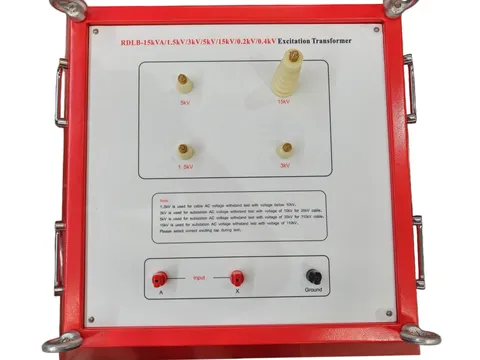
Series resonant test system, view 2 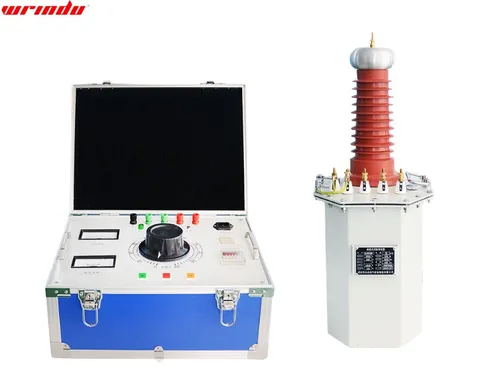
AC hipot test set, view 3
Series resonant test system models and specifications
| Serial No. | Equipment Name | Model and Specification | Unit | Quantity |
|---|---|---|---|---|
| 1 | Excitation Transformer | RDJLB-80kVA/5kV/7kV/0.4kV | Unit | 1 |
| 2 | Resonant Operating Console | RDXZL-80kW/380V | Unit | 1 |
| 4 | Adjustable Reactor | RDDK-500kVA/50kV 8~50H | Unit | 1 |
| 5 | Fixed Reactor | RDDK-300kVA/50kV 20H | Unit | 1 |
| 6 | AC Voltage Divider | FRC-50kV | Set | 1 |
| 7 | Test Cable | — | Set | 1 |
| Parameter | Value |
|---|---|
| Item | Specification |
| Rated Capacity | 80 kVA |
| Input Voltage | 380V, Three-phase |
| Input Current | 200A |
| Overcurrent Capacity | 110% of rated current (In) for 1 minute |
| Output Voltage | 5 kV / 7 kV |
| Structure Type | Oil-immersed self-cooling type |
| Parameter | Value |
|---|---|
| Item | Specification |
| Rated Output Capacity | 80 kW |
| Operating Power Supply | 380V, Three-phase, Power Frequency |
| Output Voltage | 0–430V |
| Rated Input Current | 210A |
| Rated Output Current | 210A |
| Output Waveform | Sine Wave |
| Voltage Measurement Accuracy | 1.5% |
| Operating Time | 5 minutes continuous operation under rated capacity |
| Maximum Component Temperature Rise | ≤65K after 5 minutes continuous operation at rated capacity |
| Noise Level | ≤50 dB |
| Parameter | Value |
|---|---|
| Item | Specification |
| Rated Capacity | 500 kVA |
| Rated Voltage | 50 kV |
| Rated Current | 10 A |
| Inductance | 8–50 H per unit |
| Quality Factor (Q) | ≥30 (at 50 Hz) |
| Overvoltage Capacity | 1.1 times rated voltage (1 minute) |
| Structure Type | Oil-immersed, adjustable iron-core type |
| Parameter | Value |
|---|---|
| Item | Specification |
| Rated Capacity | 300 kVA |
| Rated Voltage | 50 kV |
| Rated Current | 6 A |
| Inductance | 20 H per unit |
| Quality Factor (Q) | ≥30 (at f = 50 Hz) |
| Overvoltage Capacity | 1.1 times rated voltage (1 minute) |
| Structure Type | Dry type |
| Parameter | Value |
|---|---|
| Item | Specification |
| Rated Voltage | AC 50 kV |
| Voltage Division Ratio | 1000:1 |
| Measurement Accuracy | AC Effective Value Class 1.0 |
How a Resonant Test System Works
At the resonant frequency the inductive reactance of the reactor equals the capacitive reactance of the test object, and the two cancel. The current circulating between reactor and object is then limited mainly by the losses of the circuit, while the supply has to deliver only those losses plus the small excitation of the regulator. This is why a resonant test system can apply a high AC withstand voltage from a supply that is a small fraction of the test power. Voltage and current stay close to sinusoidal, which suits insulation testing.
In a test, the set is tuned until the circuit is at resonance, the voltage is raised to the specified level, held for the agreed time and then reduced. Tuning is done by changing frequency, or by selecting reactor taps for coarse matching before fine adjustment. If the object breaks down, the circuit detunes and the voltage collapses, so the set sees a much lower current than a conventional test transformer would. Where partial discharge is measured at the same time, partial discharge test equipment is used alongside the resonant set.
On the Wrindu Series Resonance Transformer Withstand Voltage and Partial Discharge Test System, the control system features automatic resonant frequency tracking and allows automatic scanning across multiple frequency ranges. That shortens the search for the resonant point after each change of test object, and it keeps the operating point stable while the voltage is held.
Test Set-Up, Operation Modes and Sourcing from Wrindu
Setting up the circuit is mostly a matter of matching reactor taps to the measured capacitance of the object before the test starts, keeping the high-voltage lead short and the return path direct, and grounding the object and the set at the same point. The capacitive divider is connected at the object terminal, so the voltage seen by the object is the voltage measured. For a wider view of withstand testing methods, see the guide to dielectric withstand testing.
The control system of the Wrindu Series Resonance Transformer Withstand Voltage and Partial Discharge Test System supports both manual and automatic testing modes, so a routine withstand test and a step-by-step investigation can run from the same unit.
Wrindu is the brand name of Rui Du Mechanical and Electrical (Shanghai) Co., Ltd., which was established in 2014 and has over 10 years of professional experience in global market service. The company is located in Shanghai, China, and has exported products to more than 120 countries, with main markets in South Asia, Southeast Asia and Africa. Many listings on the Wrindu Alibaba store show a minimum order of 1 set. Payment is accepted by T/T and PayPal in USD or CNY, with FOB terms, express delivery and Shanghai as the nearest port.
OEM and ODM customized products are available. The normal order runs from your test object, voltage level and the tests needed, through a selection proposal and the order itself, to pre-delivery inspection, packing and shipping, followed by training. During the 12-month warranty Wrindu provides free training, manuals, complaint response and software upgrades, and the after-sales team offers installation, training and maintenance support; maintenance and spare parts remain available after the warranty. Details can be sent through the contact page.
Request a quotation
Share the equipment under test and the tests you plan to run.
Or write to sales@hipottestequipment.com