Dielectric Withstand Voltage Test: How It Works and What It Verifies
A dielectric withstand voltage test applies a controlled over-voltage to insulation and watches what the leakage current does. This guide explains how the test is run, how results are read, and how to choose a tester for transformers, cables and switchgear.
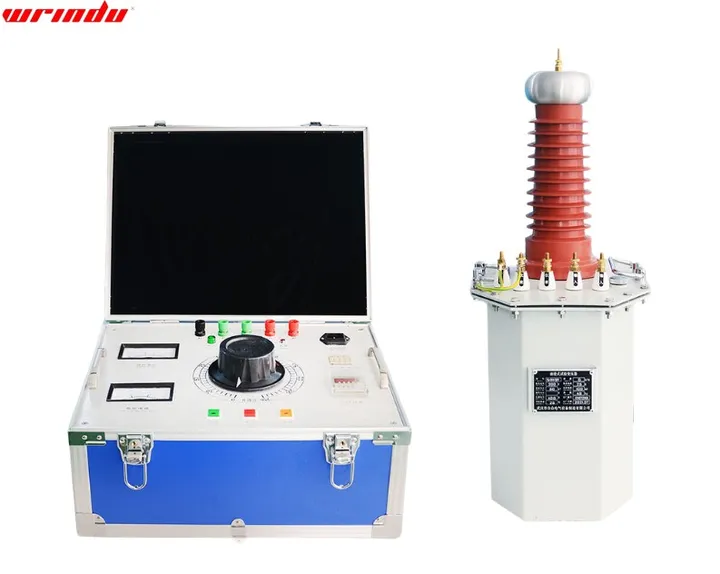
Dielectric Withstand Voltage Test: How It Works and What It Verifies
A dielectric withstand voltage test is an over-voltage insulation check. The tester applies a controlled AC or DC high voltage across the insulation of the equipment under test, holds it for a defined period, and observes the leakage current and any breakdown behaviour. The applied voltage is set above the working voltage, so weak insulation shows itself on the test bench rather than in service. What the test proves is dielectric strength: that the insulation carries the over-voltage without breakdown or flashover.
Results are read as pass or fail rather than as a measuring curve. A pass means the insulation held the applied voltage for the full test duration, with leakage current staying within the set limit and no flashover, tracking or breakdown. A fail appears as leakage current climbing steadily, a sudden jump, an audible or visible discharge, or the tester tripping on over-current. Borderline readings are reviewed against earlier results on the same item and against a separate resistance measurement.
Grounding and discharge are part of the method, not an afterthought. The test set and the object under test are bonded to a common earth before the high voltage is switched on, so fault current has a defined path instead of finding one through the operator. After the test the capacitance of the object stays charged, and the earth rod and discharge procedure release that charge before anything is touched. Skipping either step turns a routine check into an arc-flash hazard.
The test is applied to transformers, cables, switchgear, bushings, motors and other high-voltage equipment, after assembly, after repair or rewinding, and during periodic maintenance. It answers a narrow question: does the insulation hold this over-voltage? It does not show how much margin is left, which is why withstand results are normally read together with insulation resistance, tan delta and partial discharge measurements on the same item.
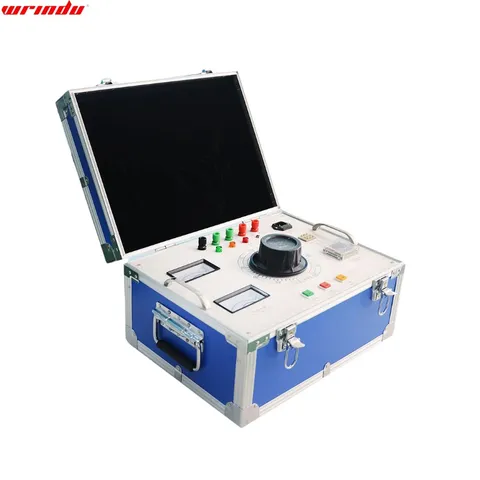
AC hipot test set, view 2 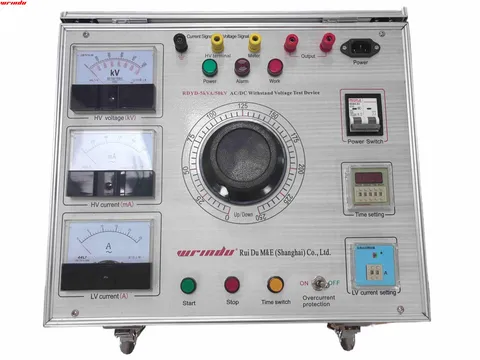
AC hipot test set, view 3
How to Choose a Dielectric Withstanding Voltage Tester
A dielectric withstanding voltage tester applies a set high voltage to the item, measures the leakage current that flows through the insulation, and detects breakdown when the current runs away or the output collapses. The useful reading is the leakage current at the test voltage, taken after the voltage has been held for the set duration. Nothing beyond that is inferred from the instrument display.
- Bond the tester earth and the earth of the item to one point before any lead is connected.
- Run the high-voltage lead to the conductor under test and keep the return path short and clear of other cabling.
- Set test voltage, current limit and duration, then raise the voltage and watch the leakage current.
- Reduce the voltage, switch off, and discharge the item with an earth rod before disconnecting anything.
“Dielectric tester” is a broad label for instruments that check insulation performance, and it covers withstand testers as well as resistance meters. A dielectric withstand tester stresses insulation with a high voltage and looks for breakdown; an insulation resistance tester applies a low voltage and measures resistance, giving a value that can be trended over time. The same buyer often uses both: resistance for acceptance and condition tracking, withstand testing as proof of dielectric strength, and either one for troubleshooting.
Choosing a dielectric withstand tester starts with the output type, AC, DC or both, together with the voltage and current the item needs. Load capacitance sets how much current the set must deliver, and duty cycle decides whether a short-rated set is enough. Controls, metering and safety interlocks matter on site, as do grounding and discharge accessories, portability and available site power. Wrindu supplies the RDXZF series resonance withstand voltage test system and the RDXZL power frequency series resonant test system for high-voltage withstand testing, the RDYD series power frequency AC withstand voltage testing device, and the RDYDTW withstand voltage and partial discharge test device.
Matching the Test Voltage Type to the Equipment Under Test
The output type follows the insulation and the object. Power frequency AC at 50/60Hz reproduces the stress that equipment on an AC network meets in service, and it is the usual choice for switchgear, transformers and bushings. DC output suits items that work under DC stress and items with large capacitance, where the charging current of an AC test would be heavy. Very low frequency AC keeps the charging current of long cable runs low enough for a portable set to stress the cable.
Wrindu supplies AC hipot testers and AC/DC units, VLF hipot testers and resonant test systems, so the output can be matched to the item rather than the other way round. The RDYD series power frequency AC withstand voltage testing device is offered with a small, light and compact structure, complete functions, strong universality and convenient use. A set that combines output types saves transport weight, but it must still deliver the current the largest item in the fleet demands.
Specifying and Ordering Withstand Test Equipment
Buyers usually start by sending the test object, the voltage level and the tests required. Wrindu replies with a selection proposal for a tester or a complete test system, and the order follows once the scope is agreed. Pre-delivery inspection and packing come before shipping; after-sales training is available.
During the 12-month warranty, Wrindu provides free training, manuals, complaint response and software upgrades. The after-sales team offers installation, training and maintenance support, and maintenance and spare parts remain available after the warranty ends. Wrindu also provides OEM and ODM customized products for buyers who need a different configuration.
Wrindu is the brand name of Rui Du Mechanical and Electrical (Shanghai) Co., Ltd., established in 2014 and based in Shanghai. The company has over 10 years of professional experience in global market service and has exported to more than 120 countries, with South Asia, Southeast Asia and Africa as main markets. Payment is accepted by T/T and PayPal in USD or CNY, delivery is FOB (nearest port: Shanghai) or by express, and many listings show a minimum order of 1 set.
Request a quotation
Share the equipment under test and the tests you plan to run.
Or write to sales@hipottestequipment.com