DC Hipot Tester for Cable and Substation Insulation Testing
A DC hipot tester applies a DC high voltage to a test object and reads the resulting leakage to judge insulation withstand. Wrindu, the brand of Rui Du Mechanical and Electrical (Shanghai) Co., Ltd., supplies DC hipot testers and related high voltage test equipment.
Request a quotation for this equipment
- Warranty
- 12-month warranty
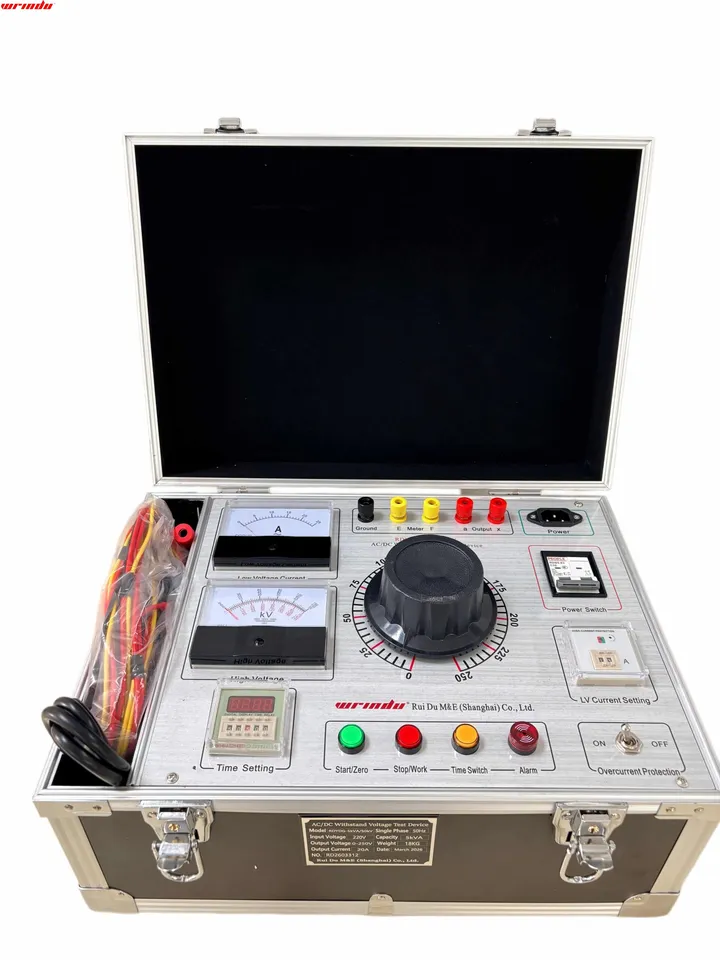
How Do You Choose a DC Hipot Tester for Cable, Motor and Switchgear Insulation Testing?
A dc hipot tester is equipment that applies a DC high voltage to check insulation withstand and leakage behaviour in cables, motors, switchgear and other power equipment. Because the applied voltage is direct rather than alternating, the charging current of a capacitive load falls away and the steady leakage reading is easier to follow. Wrindu supplies these testers as part of its power testing equipment range.
- Output voltage high enough to reach the test level the object requires.
- Output current sufficient to charge the load capacitance in a workable time.
- Ramped or stepped voltage control with a leakage current limit and trip.
- Discharge and grounding provisions sized for the capacitance being tested.
- Portability and power supply suited to field or laboratory work.
Wrindu is the brand name of Rui Du Mechanical and Electrical (Shanghai) Co., Ltd., established in 2014, with over 10 years of professional experience in global market service. To select a model for a cable, motor or switchgear test, send the test object, the voltage level and the tests needed through the inquiry form; Wrindu replies with a selection proposal.
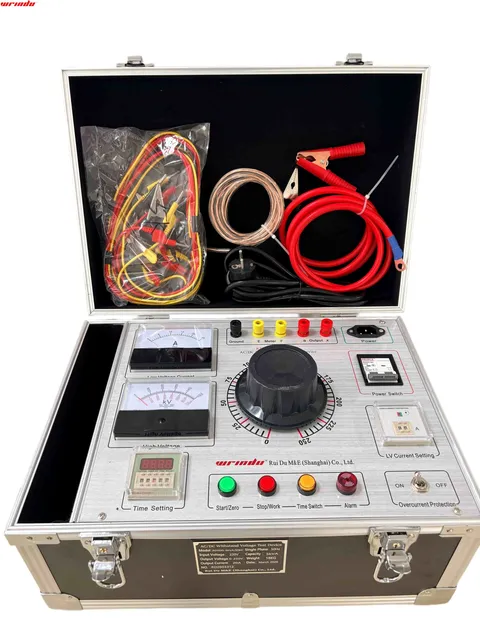
DC hipot tester, view 2 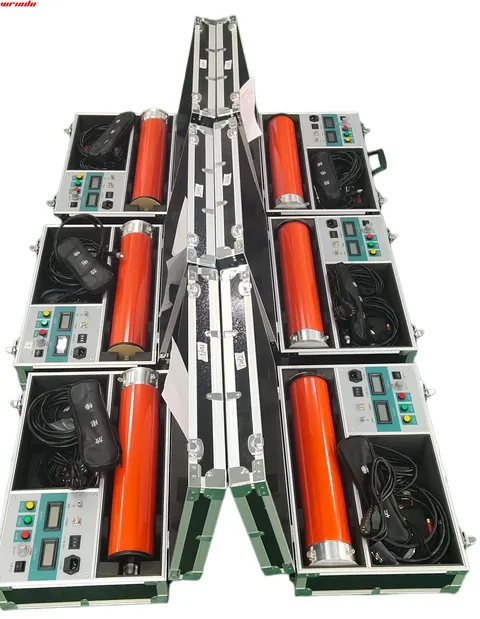
DC hipot tester, view 3
DC hipot tester models and specifications
| Parameter | Value |
|---|---|
| Dry-Type Test Transformer | Specification |
| Capacity | 5 kVA |
| Output Voltage | 50 kV AC / 70 kV DC |
| Output Current | 100 mA |
| Input Voltage | 200 V |
| Input Current | 25 A |
| Parameter | Value |
|---|---|
| Manual Console | Specification |
| Capacity | 5 kVA |
| Input Voltage | 200 V |
| Input Current | 25 A |
| Output Voltage | 0–250 V |
| Output Current | 20 A |
| Operating Mode | Manual |
| Parameter | 120/2 | 120/3 | 120/5 |
|---|---|---|---|
| Rated Voltage | 120 kV | ||
| Rated Current | 2 mA | 3 mA | 5 mA |
| Rated Power | 240 W | 360 W | 600 W |
| Weight | 10 kg | ||
| Dimensions | 565 × 390 × 190 mm | ||
| Cylinder Height | 535 mm | ||
| Output Voltage Accuracy | ±(1.0%rdg ± 2dgt) | ||
| Output Current Accuracy | ±(1.0%rdg ± 2dgt) | ||
| Ripple Coefficient | ≤0.5% | ||
| Operating Mode | Intermittent operation, rated load for 30 minutes | ||
| Overload Capacity | No-load voltage can exceed rated voltage by 10% for 10 minutes; Maximum charging current: 1.25 times rated current | ||
| Power Supply | AC 220V ±10%, 50Hz | ||
| Working Environment | Temperature: -10℃ to 40℃; Relative humidity: ≤85% (25℃, no condensation); Altitude: <1500 m |
| Parameter | Value |
|---|---|
| Parameter | Specification |
| Rated Voltage | 200 kV |
| Rated Current | 10 mA |
| Rated Power | 2000 W |
| Weight | 6.5 kg + 9 kg |
| Cylinder Height | 970 mm |
| Output Voltage Accuracy | ±(1.0%R ± 2d) |
| Output Current Accuracy | ±(1.0%R ± 2d) |
| Ripple Coefficient | ≤ 0.5% |
| Working Mode | Intermittent use, 30 minutes under rated load |
| Overload Capacity | No-load voltage can exceed rated voltage by 10% for 10 minutes; maximum charging current 1.25× rated current |
| Power Supply | AC 220V ± 10%, 50Hz/60Hz |
| Working Ambient Temperature | -10 ~ 40℃ |
| Working Ambient Relative Humidity | ≤ 85% at 25℃ (no condensation) |
| Working Ambient Altitude | < 1500 m |
What Is a DC Hipot Test?
DC hipot means a dielectric withstand test that uses direct high voltage rather than AC. It is used on objects that behave as capacitors, such as power cables and motor or generator windings, because a DC source charges that capacitance with far less current than an AC source at the same level. Leakage current is monitored throughout the test, and that reading shows whether the insulation is holding or breaking down.
A dc hipot test follows a fixed order. The object is disconnected from service and isolated, and the tester is connected across the insulation to be checked. The voltage is raised gradually, held for the required test period, and the leakage current is watched for stability. At the end, the voltage is reduced, the object is discharged and then grounded before anyone touches it. Test parameters come from the applicable standard and the equipment instructions.
The result shows the insulation withstand condition of the object at the applied voltage. A stable leakage reading within the set limit indicates that the insulation held; a rising or unstable current, or a trip, points to a problem that needs investigation. Acceptance values differ by object and standard. Wrindu supplies DC hipot testers for this work, and the specification tables on this page list the model parameters. Send the test object and tests needed through the inquiry form for a model proposal.
Can One Tester Perform AC and DC Hipot Tests?
An ac dc hipot tester provides both AC and DC withstand test modes, so the method can be matched to the object and to the standard being applied. AC mode is used where an alternating test voltage is required. DC mode suits capacitive loads such as cables and windings, where direct voltage keeps charging current manageable. A dual-mode instrument covers a wider set of test objects without a second unit.
Wrindu supplies several models with both modes.Wrindu also supplies a multi-functional VLF hipot tester with tan delta and capacitance measurement; partial discharge testing and DC leakage measurement are optional configurations of that model. The Wrindu RD5251 is an AC/DC hipot dielectric withstand voltage tester, and the Wrindu RDS51052 is a portable AC/DC dielectric withstand voltage tester (hipot tester).
For a given test object, the choice depends on the voltage level, the capacitance of the load and the tests required. Readers can confirm the suitable model for their test object through the inquiry form. The AC hipot testers and VLF hipot testers pages cover the alternating and low-frequency side of the range.
Ordering and Service for Wrindu DC Hipot Testers
Orders follow a plain sequence. The buyer sends the test object, the voltage level and the tests needed, and Wrindu returns a selection proposal. The order is then placed, the equipment is inspected before delivery and packed, shipping follows, and training is provided. Buyers can also read the dielectric withstand test guide before choosing a model.
During the 12-month warranty, Wrindu provides free training, manuals, complaint response and software upgrades. The after-sales team offers installation, training and maintenance support, and maintenance and spare parts remain available after the warranty. OEM and ODM customized products are available, and many Wrindu listings on its Alibaba store show a minimum order of 1 set.
Wrindu accepts T/T and PayPal in USD or CNY. Delivery terms are FOB and express delivery, and the nearest port is Shanghai. Wrindu is located in Shanghai, China, has exported products to more than 120 countries, and exhibits at international power industry events, including MEE Dubai 2025, ETE Vietnam 2024, Power and Energy Africa 2023 and Middle East Energy Dubai 2023.
How an order runs
- Send your requirements
- The equipment you need to test, its voltage level and the tests you plan to run.
- Selection and quotation
- Wrindu proposes matching tester models and accessories and sends a quotation.
- Inspection and delivery
- Equipment is inspected and packed before delivery; the delivery time is confirmed with the quotation.
- Warranty and training
- During the 12-month warranty, Wrindu provides free training, manuals, complaint response and software upgrades.
Request a quotation
Tell us the voltage, capacity or cable length you need to test.
Or write to sales@hipottestequipment.com