Tan Delta Test: A Practical Guide for Transformers, Cables and Capacitors
A tan delta test measures dielectric loss in insulation, and it is one of the clearer indicators of moisture, contamination or ageing in a transformer, cable or capacitor. This guide covers the measurement, the test sequence and the equipment Wrindu supplies.
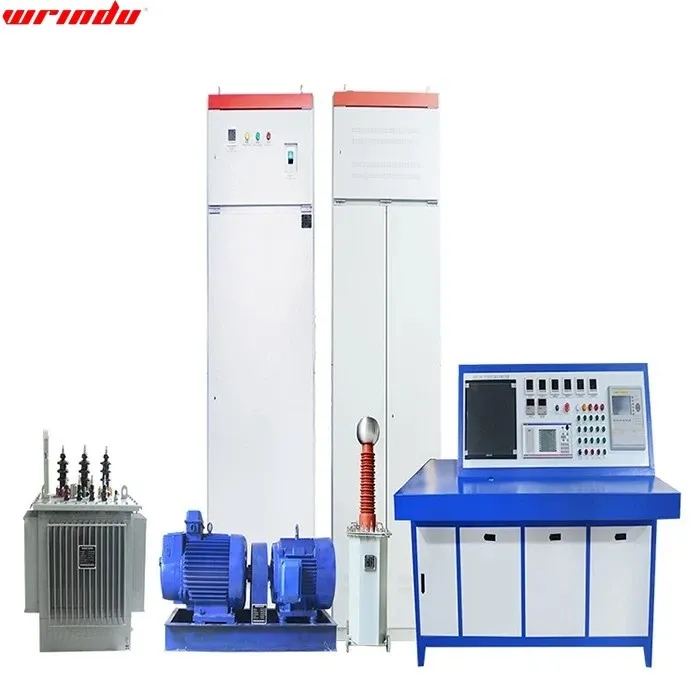
What a Tan Delta Test Measures and Why It Matters
A tan delta test measures dielectric loss in insulation. An AC voltage is applied to the item under test, and the instrument compares the resistive leakage current, which dissipates energy as heat, with the capacitive current that charges the insulation. Dry, healthy insulation keeps the resistive part small, so the measured ratio stays low. The result is reported as the loss angle tangent, or dissipation factor, and it describes insulation condition rather than a single breakdown point.
The measurement matters for transformers, cables, bushings and capacitors because each depends on insulation that stays dry and clean. One value tells little on its own, but the trend matters: readings taken at intervals show whether loss is stable or drifting, and comparing phases or similar units on the same site adds a reference point. That record is what supports an insulation condition assessment over the service life of the equipment. Wrindu is a tan delta test and transformer testing equipment supplier, and its transformer test equipment range covers this work.
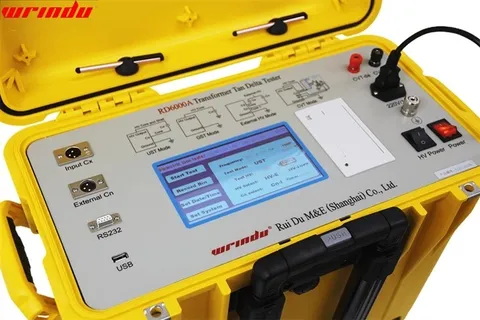
Transformer tester, view 2 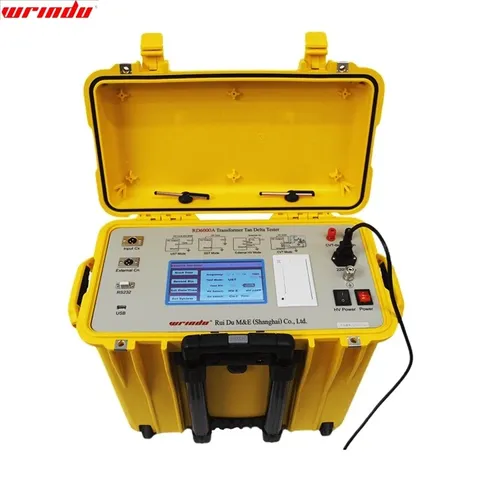
Transformer tester, view 3
Tan Delta and Tangent Delta: What Do the Terms Mean?
Tangent delta and tan delta describe the same dielectric loss measurement. The loss angle is the angle by which the current through the insulation departs from a purely capacitive quarter turn, and the tangent of that angle is the ratio of resistive to capacitive current. Reports and product names use the full word or the shortened form interchangeably, so a value written as tangent delta in one document and tan delta in another is one quantity.
Tan delta therefore means the ratio that expresses dielectric loss in insulation. A low value generally suggests healthy insulation, while a rising value can point to moisture, contamination, ageing or damage, especially where the change appears between tests on the same item or between phases. Because both terms name the same measurement, records are compared on that basis rather than treated as separate results.
Choosing a Tan Delta Tester
A tan delta tester has to suit the objects tested most often and the place where testing happens. Selection usually comes down to measurement mode, how the instrument handles interference from nearby energized equipment, portability, power supply and the range of test objects it supports.
- Measurement mode: check which connections the tester supports for grounded and ungrounded specimens.
- Interference handling: substation noise distorts small loss readings, so filtering and frequency-based measurement help.
- Portability and power: case design, weight and supply requirements decide whether the tester travels to site easily.
- Test objects: confirm the capacitance and loss range suits the transformers, cables, capacitors and bushings you test.
Wrindu supplies the RD6001 Capacitance & Tan Delta Tester, the RD6000B Transformer Tan Delta Test Equipment and the RD6000C Transformer Tan Delta Test Kit. The RD6000B and RD6000C use frequency-conversion power technology rather than the traditional bridge measurement method.
How Is a Tangent Delta Test Performed?
The sequence for a tangent delta test is similar across equipment types. Identify the item and the insulation section to be measured, choose the matching test mode, then isolate and discharge the item before any lead is connected. Once the tester is connected and its ground and guard leads are checked, the AC test voltage is applied and the capacitance and dielectric loss values are recorded.
- Confirm the item is de-energized, isolated and earthed before connecting leads.
- Discharge the insulation after each measurement and keep the test area clear.
- Check ground and guard connections, because a poor ground distorts loss readings.
- Follow the site switching and permit procedures throughout the test.
Compare the recorded values with earlier results for the same item, with the other phases, or with similar units on site. The RD6001 Capacitance & Tan Delta Tester is a named option in the Wrindu range for capacitance and dielectric loss measurement.
Capacitor Tan Delta Measurement
Capacitor tan delta assesses the dielectric losses inside a capacitor’s own insulation. The tester measures the capacitance of the unit and its loss tangent at the same time, so a capacitor that has lost capacitance or developed internal damage usually shows a change in the energy its insulation dissipates. A single degraded unit changes how the whole bank divides voltage, which is why banks are measured unit by unit.
Wrindu supplies the RD6001 Capacitance & Tan Delta Tester and the RDLC-503XB tester for compensation capacitors, reactors and resistors. On a bank, compare each unit with the others in the bank as well as with its own earlier results, so that a weak unit stands out.
Tan Delta Cable Test Methods
A tan delta cable test is used as a diagnostic measurement of cable insulation condition rather than a proof test. The cable is isolated and discharged, terminations are cleaned and the phases identified, then a test voltage is applied and the loss is recorded for each length or section. Results are read as trends: insulation that has taken in moisture or been damaged in service shows loss that rises across tests or differs from comparable circuits.
Wrindu supplies tan delta instruments alongside VLF hipot testers and partial discharge test equipment for cable work. Where a diagnostic result points to a fault, the next step is location rather than a further loss measurement.
Tan Delta Test of Transformer Insulation
A tan delta test of transformer insulation looks at dielectric losses in winding insulation, bushings and the oil-paper system. Bushings are often measured individually, while winding measurements compare capacitance and loss to earth and between windings. Loss depends strongly on temperature, so results are compared at similar temperatures, and the trend across tests on one transformer carries more weight than a single reading.
Wrindu supplies the RD6000B Transformer Tan Delta Test Equipment and the RD6000C Transformer Tan Delta Test Kit for this work. Both use frequency-conversion power technology instead of the traditional bridge measurement method. Insulation resistance measurement and oil testing support the same assessment from other angles.
Ordering Tan Delta Test Equipment from Wrindu
Wrindu is the brand name of Rui Du Mechanical and Electrical (Shanghai) Co., Ltd., established in 2014 and based in Shanghai, China, with over 10 years of professional experience in global market service. Products have been exported to more than 120 countries, and South Asia, Southeast Asia and Africa are the main markets. The usual order path runs from a selection proposal based on the test object, voltage level and tests needed, through order, pre-delivery inspection and packing, shipping, to training.
During the 12-month warranty, Wrindu provides free training, manuals, complaint response and software upgrades. The after-sales team offers installation, training and maintenance support, and maintenance and spare parts remain available after the warranty. Many Wrindu listings on its Alibaba store show a minimum order of 1 set.
Payment is by T/T or PayPal in USD or CNY; delivery terms are FOB and express delivery, and the nearest port is Shanghai. Wrindu also provides OEM and ODM customized products, has exhibited at MEE Dubai, ETE Vietnam, Power and Energy Africa and Middle East Energy Dubai, and receives enquiries through the contact page.
Request a quotation
Share the equipment under test and the tests you plan to run.
Or write to sales@hipottestequipment.com