Cable Fault Locator: How to Find and Pinpoint Underground Cable Faults
A cable fault locator is a system rather than a single instrument: it estimates the distance to a fault, makes the fault flash over, and pinpoints the position at the surface. Wrindu supplies these systems and the test equipment used alongside them.
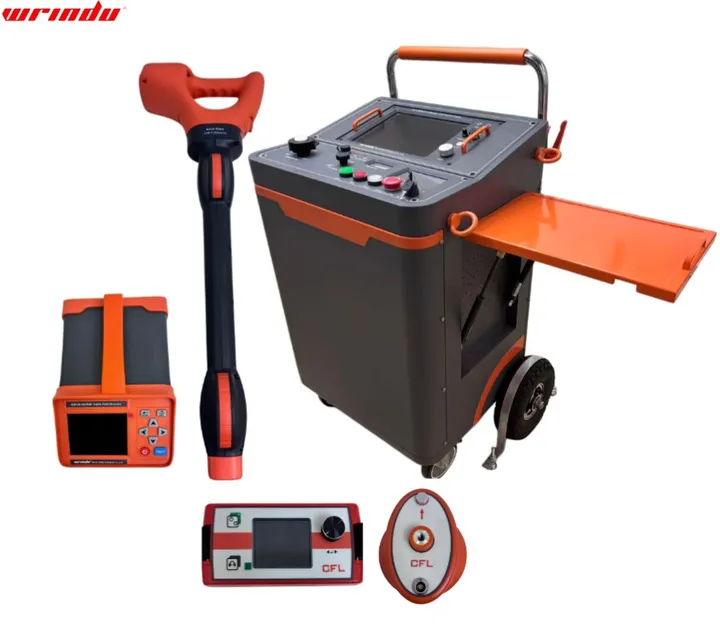
How a Cable Fault Locator System Finds a Buried Fault
A cable fault locator is a working system rather than a single box. It usually combines insulation and fault pre-location, which estimates the distance from the test end to the fault, a high-voltage surge or signal source that makes the fault flash over, acoustic or acoustic-magnetic pinpointing at the ground surface, and cable route detection so the crew knows where to walk. Each part answers a different question: how far along the cable, whether the fault can be made to discharge, exactly where it sits, and which line to follow above ground.
Wrindu supplies this kind of equipment. The RDCD-C is an integrated mobile cable fault diagnosis system for power cable inspection, fault diagnosis, field maintenance, fault location, high-voltage testing, acoustic pinpointing and cable route detection, built as a mobile unit.
In practice the stages run in order. Pre-location narrows a long route to a short section, the surge source makes the fault discharge so it can be heard, and acoustic pinpointing marks the spot for excavation. Route detection runs alongside, because a distance along a cable is only useful when the crew can follow the same path above ground and mark it before digging.
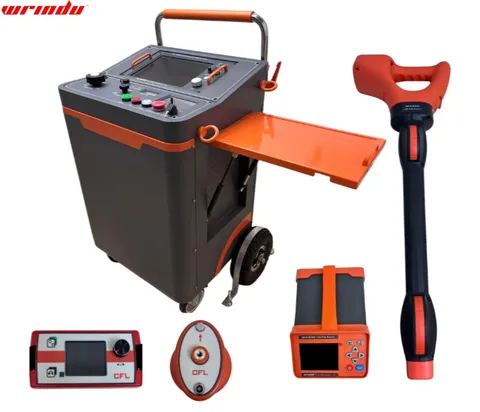
Cable fault locator, view 2 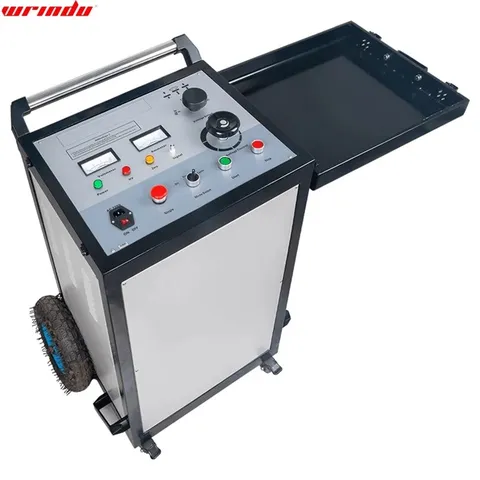
Cable fault locator, view 3
Cable fault locator models and specifications
| Parameter | Value |
|---|---|
| Item | Technical Parameter |
| Output Voltage | 0–32 kV continuously adjustable |
| High-Voltage Startup | Authorization key required |
| Built-in Capacitance | 64 μF/8 kV; 16 μF/16 kV; 4 μF/32 kV |
| Maximum Impact Energy | 2048 J |
| Operating Modes | Continuous impulse flash; Single impulse flash |
| Continuous Pulse Period | 1–10 seconds |
| Display | 5-inch color LCD, 800×480 |
| Interface | Chinese prompts, numerical display |
| Control Software | Stable under high voltage |
| Automatic Discharge | Auto discharge after emergency stop / power failure |
| Input Voltage | AC 220V ±10% / 50Hz |
| Dimensions | 750mm × 560mm × 915mm |
| Weight | 130 kg |
| Parameter | Value |
|---|---|
| Item | Details |
| Display & Interface | 12.1-inch high-brightness LCD, knob control, sunlight-readable, lithium battery, shockproof & moisture-resistant case |
| Wireless | WIFI + SIM interface, remote data transmission, 8 auto sampling frequencies (3.125MHz–400MHz) |
| Testing Modes | Auto-switch among Low Voltage Pulse, Impulse Current, Multiple Pulse; auto fault recognition & distance calculation |
| Waveform Analysis | Tri-zone display, 10 waveforms for comparison, storage & playback |
| Multiple Pulse Generator | 10 low-voltage short-circuit pulses per discharge, anti-interference |
| Precision Locator | Dual-filter noise cancellation, real-time distance & path direction |
| Mobile & APP | Bluetooth, wireless headset, professional APP for analysis & training |
| Parameter | Value |
|---|---|
| Item | Technical Parameter |
| Testable Faults | Open circuit, short circuit, low resistance, high resistance leakage, high resistance flashover |
| Display | 12.1-inch industrial LCD (Linux OS) |
| Storage | 32GB SSD |
| Languages | Chinese, English, Russian |
| Testing Methods | Low Voltage Pulse, High Voltage Impulse, Multiple Pulse |
| Operation | Touchscreen + optical encoder knob |
| Pulse Width / Amplitude | 100ns~10μs, 120V |
| Gain Adjustment | -20…+40dB |
| Output Impedance | 120Ω |
| Remote Connectivity | WIFI + SIM |
| Test Distance | 5m–100km |
| Blind Zone | 5m |
| Localization Accuracy | ±0.2m |
| System Error | ≤±1% |
| Multiple Pulse Generator | Impact voltage ≤40kV |
| Resolution | v/(2f) m |
| Sampling Frequencies | 400MHz, 200MHz, 100MHz, 50MHz, 25MHz, 12.5MHz, 6.25MHz, 3.125MHz |
| Power | AC 220V±10%, ≤15W; DC 12V (7AH), ≤20W |
| Battery Life | Up to 6 hours |
| Parameter | Value |
|---|---|
| Item | Specification |
| Sensor Dynamic Range | Sound channel: >104 dB Magnetic field channel: >110 dB |
| Sensor Frequency Range | 100 Hz – 1500 Hz |
| Impact Discharge Sound Amplification | >90 dB Impact discharge volume upper limit: 84 dB(A) (on/off switchable) |
| Filter Settings | No filter: 100 Hz – 1500 Hz |
| Filter Modes | Low-pass filter: 100 Hz – 400 Hz Band-pass filter: 150 Hz – 600 Hz High-pass filter: 200 Hz – 1500 Hz |
| LCD Display | High-brightness true color screen (320×240 pixels), suitable for outdoor use |
| On-site Continuous Working Time | Powered by replaceable alkaline batteries for convenient field operation |
| Parameter | Value |
|---|---|
| Model | RDCD-523W |
| Parameters | Value |
| Input voltage | 200~240V,50Hz |
| Output voltage | 0~10kV adjustable (square wave) |
| Output current | Max 200mA |
| Output capacity | 2kVA |
| Frequency regulation | 0.4Hz~1Hz (adjustable) |
| Parameter | Value |
|---|---|
| Model | RDCD-Ⅱ-503B |
| Acoustic synchronous function | Acoustic synchronous function |
| (1) Sound channel | (1) Sound channel |
| Bandwidth | Full 100 Hz ~ 1500 Hz; Low pass: 100 Hz ~ 400 Hz; High pass: 150 Hz ~ 1500 Hz; Band pass 200 Hz ~ 600 Hz. |
| Signal gain | 0 -7 adjustable |
| Fixed point accuracy | 0.1m |
| (2) Magnetic field channel | 0 -7 adjustable |
| Acoustic synchronous background noise reduction mode (BNR) | Acoustic synchronous background noise reduction mode (BNR) |
| The bar chart of sound intensity indicates that the threshold of the sound trigger (0 ~ 100) can be adjusted | The bar chart of sound intensity indicates that the threshold of the sound trigger (0 ~ 100) can be adjusted |
| The bar chart of electromagnetic intensity indicates that the magnetic field trigger threshold (0 ~ 100) can be adjusted, and it has the function of a magnetic field trigger prompt. | The bar chart of electromagnetic intensity indicates that the magnetic field trigger threshold (0 ~ 100) can be adjusted, and it has the function of a magnetic field trigger prompt. |
| Acoustic magnetic time difference method positioning mode: waveform display, acoustic magnetic time difference display. | Acoustic magnetic time difference method positioning mode: waveform display, acoustic magnetic time difference display. |
| Power supply | Power supply |
| Battery | Built-in lithium-ion battery pack, voltage 8.4V, capacity 2.4Ah Use time: continuous use time > 8 hours |
| Charger | Input AC 220V±10%, 50Hz;; Nominal output 8.4V, 1A |
| Charging time | < 6 hours |
| Display mode | 5-inch color LCD with 854*480 resolution and touch function |
| Operating environment temperature | -25℃ ~ 40℃, humidity 5 ~ 90% RH, altitude < 4500m. |
Underground Cable Fault Finder vs Locator: What’s the Difference?
Buyers use underground cable fault finder, locator and detector for the same job on buried cables, and the practical difference is not the name but the stage. Pre-location gives a distance along the route; pinpointing tells you where to dig. For the distance stage Wrindu supplies the RDCD-750 Cable Fault Pre-locator and the RDCD-III/RA52 Trolley-type Cable Fault Pre-locator with 3 built-in capacitance gears for various voltage-level cable insulation fault detection.
For the pinpointing stage Wrindu supplies the RDCD-II-503D Buried Cable Detector, which pinpoints the exact location of cable faults using acoustic-magnetic synchronization, and the RDCD-II/535T high-voltage signal generator, a source for locating and pinpointing issues in power cables. The optional A-frame is available for cable ground fault location, suitable for both muddy and cement grounds, and detects step voltage signals to locate grounding faults in directly buried cables.
When the cable is buried and cannot be seen, the locator works from signals: a pulse or surge sent down the cable, the reflection or flashover it produces, and the acoustic or electromagnetic signal that reaches the surface above the fault. Route tracing comes first so the crew knows the path — the NF-826 Underground Wire Locator detects an electric wire’s signal below the ground. Distance estimation follows on that path, and surface pinpointing closes the job.
Selection follows the network, not the catalogue. Start with the cable voltage class and insulation type, then decide whether distance estimation alone is enough or acoustic pinpointing is needed too. Directly buried faults point to step-voltage work with the optional A-frame; joints and outer sheaths call for the RDCD-521W Cable Outer Sheath Fault Tester, which uses the MURRAY bridge principle to detect high-resistance breakdowns in joints and flashover points. Format matters as well: portable, trolley-type or the integrated RDCD-C. Send the cable type and fault symptoms through the inquiry form for a model recommendation.
What Counts as a Cable Fault?
A cable fault is a breakdown of the insulation or of the conductor path. In general terms it covers open-circuit and short-circuit faults, low-resistance and high-resistance faults, flashover faults that appear only when voltage is applied, ground faults on directly buried cable, and outer-sheath or jacket faults that let moisture reach the screen or armour.
Each type calls for a different locating approach. Bridge methods suit high-resistance breakdowns, surge or signal injection makes a flashover audible, step-voltage detection finds ground faults on directly buried cable, and acoustic methods finish the pinpointing. Wrindu supplies the RDCD-521W Cable Outer Sheath Fault Tester for high-resistance breakdowns in joints and flashover points, and the optional A-frame for ground fault location in directly buried cables.
Before locating, a crew usually confirms which core is faulty and how badly. An insulation resistance tester gives that first reading on the suspect section, and the result steers the choice of pre-location method. Once a joint has been opened and remade, a VLF hipot test is the usual way to prove the repair holds voltage before the trench is closed.
How Does a TDR Cable Fault Locator Measure Distance?
A TDR cable fault locator works by time-domain reflectometry. A short pulse is launched into the cable, and part of it reflects wherever the impedance changes: at a joint, at water ingress, at a crushed section, at an open or short circuit. The locator converts the travel time into distance using the cable’s velocity of propagation, which depends on the insulation material and the cable construction.
The method has practical limits. A wrong velocity factor, long wet sections and very high-resistance faults blur the trace, so the reflection is hard to read or does not appear at all. That is why TDR pre-location is usually followed by surge and acoustic pinpointing. Wrindu supplies the RDCD-750 Cable Fault Pre-locator and the RDCD-III/RA52 Trolley-type Cable Fault Pre-locator, whose built-in capacitance gears cover various voltage-level cable insulation fault detection.
Before running a pulse test, the crew collects what the instrument needs: the route length, the insulation type and the position of known joints. Those details set the velocity factor and help separate a real fault reflection from the echo of a joint. The specification tables on this page list the parameters of the pre-locators Wrindu offers for this stage.
Ordering, Training and After-Sales Support
Wrindu is the brand name of Rui Du Mechanical and Electrical (Shanghai) Co., Ltd., established in 2014, with over 10 years of professional experience in global market service and products exported to more than 120 countries. The normal order path is direct: the buyer sends the cable type, voltage level and tests needed; Wrindu proposes a selection; the order is placed; pre-delivery inspection and packing follow; then shipping (nearest port: Shanghai), with after-sales training available.
Many listings on the Wrindu Alibaba store show a minimum order of 1 set. Payment is by T/T or PayPal in USD or CNY, delivery terms are FOB and express delivery, and the nearest port is Shanghai. During the 12-month warranty Wrindu provides free training, manuals, complaint response and software upgrades. The after-sales team offers installation, training and maintenance support, and maintenance and spare parts remain available after the warranty. OEM and ODM customized products are available.
Request a quotation
Share the equipment under test and the tests you plan to run.
Or write to sales@hipottestequipment.com