Battery Discharge Tester: Load Test and Capacity Guide
A battery discharge tester applies a controlled load and records voltage, current and time, so you can judge real capacity instead of resting voltage. This guide covers load tests, Ah measurement, load banks and current safety.
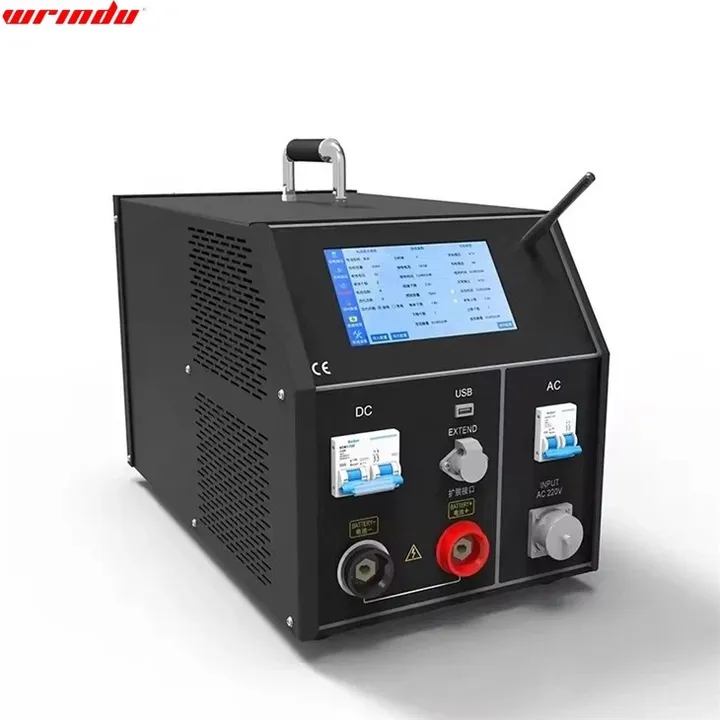
Choosing a Battery Discharge Tester for Packs and Stationary Banks
A battery discharge tester applies a controlled load to a battery or a battery bank, then records voltage, current and time while the load runs. Those records show how the battery behaves under real demand and help assess capacity or find weak cells. Choosing one comes down to battery voltage, discharge current, the cutoff point that ends the test, data recording and the safety limits of the connections.
Wrindu supplies several tools for this work. The RDBT-3018D is a tester with a built-in load. The RD-CT Series is a load bank for battery discharge test, used as an external controllable load. The RDLI-8006CT high-voltage lithium-ion battery discharger is engineered for high-voltage lithium battery pack discharge. The RD-IBC2612 battery regeneration equipment has battery discharge, battery charge and battery activation modes.
- Stationary banks and larger packs: check that the tester’s voltage window covers the whole string and that its current range suits the bank rating.
- High-voltage lithium packs: the RDLI-8006CT is the model engineered for that discharge duty.
- Modules with large voltage drops in individual cells: the RDLI-0530CT lithium battery charger discharger performs maintenance on those cells.
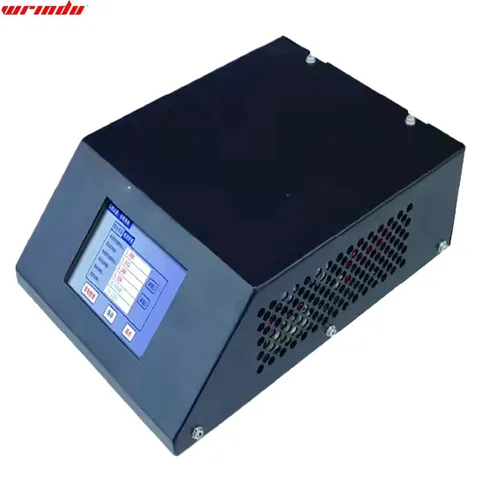
Battery test equipment, view 2 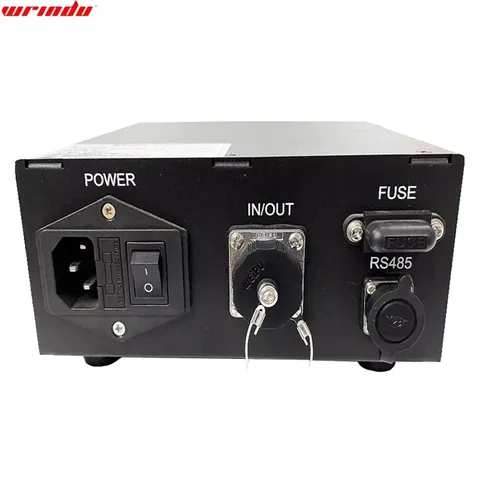
Battery test equipment, view 3
Battery discharge tester models and specifications
| Model | RDCD-A200CT | RDCD-A300CT | RDCD-10030NT | RDCD-60030NT |
|---|---|---|---|---|
| Group Voltage Range | DC 2-285V | DC 2-285V | DC 2-100V | DC 200-600V |
| Accuracy & Resolution | ±0.5%FS | |||
| Cell Voltage Range | 0-5V | |||
| Accuracy & Resolution | 0.001V | |||
| Discharge Current Range | 0-100A/7.2KW | 0-100A/7.2KW | 0-30A/2KW | 0-30A/18KW |
| Accuracy & Resolution | ±1%FS | |||
| Charge Current Range | 0-80A/4.4KW | 0-80A/6.6KW | 0-30A/2KW | 0-20A/12KW |
| Accuracy & Resolution | ±1%FS | |||
| AC Power Supply | AC220V | |||
| Working Mode | Discharge, charge, activation (discharge-charge cycle) | |||
| Communication(PC) | RS485, CAN | |||
| Protection | DC input over-voltage, polarity reversal, discharge over current, over temperature | |||
| Dimension | 512*295*339 mm | 512*295*339 mm | 452*234*286 mm | 680*554*334 mm |
| Weight | 25 kg | 28 kg | 18 kg | 40 kg |
| Parameter | Value |
|---|---|
| Model | RDLI-0530CT |
| Working Voltage | AC100-264V @50Hz |
| Voltage Range | 1.0-4.5V |
| Voltage Accuracy | ±0.2%FS+5mV@5V |
| Discharge Current | 1.0-30A ±0.5%FS +0.1A@30A |
| Charging Voltage | 1.0-4.5V |
| Charging Current | 1.0-30A ±0.5%FS+0.1A@30A |
| Display | 3.5-inch LCD touch screen |
| Communication | RS485 |
| Protection | DC input over-voltage, polarity reversal, discharge over current, over temperature |
| Dimension | 230*155*75 mm |
| Weight | 2 kg |
| Parameter | Value |
|---|---|
| Model | RDLI-4-100A |
| Discharge Voltage | 4 channel, independent, 1-5.000V |
| Discharge Current | 4 channel, independent, 1.0-100A |
| Charging Current | 4 channel, independent, 1.0-100A |
| Power Supply | AC220V |
| Working Mode | Discharge, charging, discharge-charge cycle (activation) |
| Cell Voltage Accuracy | Accuracy: ±0.2%FS+5mV; resolution: 0.001V |
| Current Accuracy | Accuracy: ±0.5%FS+0.2A; resolution: 0.1A |
| Dimension | 512*296*340mm |
| Weight | 25kg |
| Model | RDLI-1255CT | RDLI-2455 | RDLI-3655 | RDLI-4855 |
|---|---|---|---|---|
| Test Port | 1*12 | 2*12 | 3*12 | 4*12 |
| Charge & Discharge Power | Max 300W | Max 600W | Max 900W | Max 1200W |
| Voltage Range & Accuracy | 1.8-4.2V @±0.1%FS±2mV | |||
| Current Range & Accuracy | 0.1-5A @±1%FS±0.05A | |||
| Temp Range & Accuracy | -25~85℃@±2℃ | |||
| Baery Port | 16pin/24pin | 16pin/24pin | 17pin/26pin | 26pin/26pin |
| Display | 7-inch touch screen | |||
| PC Data Communication | TCP/IP, USB | |||
| Wireless Communication | WIFI, BT (WIFI antenna external) | |||
| Charge Mode | Constant current charging + constant voltage charging | |||
| Discharge Mode | Constant current discharge (constant power discharge and constant resistance discharge are oponal) | |||
| Dimension | 455*255*220mm/8.5kg | 496*246*262mm/14kg | 480*255*430mm/18kg | 480*255*590mm/29kg |
| Parameter | Value |
|---|---|
| Model | RDLI-8006CT |
| Discharge Voltage Range | 200-800V |
| Accuracy & Resolution | 0.1V; ±0.5%FS, max 800V |
| Discharge Current Range | 200-300V:0-30A; 300-400V:0-45A; 400-600V:0-60A; 600-800V:limit power to 36kW, voltage rise current reduced to 45A-60A |
| Accuracy & Resolution | 0.1A; ±1%FS, max 60A |
| Max Discharge Power | 36kw |
| Discharge Mode | constant current discharge, constant power discharge |
| Battery Port | 7 pin |
| Display | 7-inch touch screen |
| PC Data Communication | TCP/IP, USB |
| Dimension | 293*506*773 mm |
| Weight | 45 kg |
Battery Tester With Load Test: What It Reveals
A simple voltage check reads the battery at rest. A battery tester with load test goes further: it draws real discharge current and shows the voltage sag under that load, the runtime the battery can hold, and the capacity actually available. A battery that looks healthy at rest can collapse within moments under load, and the load test is what exposes that behaviour before it becomes a failure on site.
The test is the same in principle; the difference is where the load sits and how much current it can absorb. Read the result as a trend: starting voltage, voltage under load, time to cutoff and recovery.
Battery Capacity Tester: Measuring Real Ah
A battery capacity tester measures real ampere-hours. The battery is discharged at a controlled current to a defined cutoff, the tester records discharge current and elapsed time throughout, and the product of the two gives the Ah delivered. That figure is then compared with the rated capacity of the battery. A capacity tester must therefore track discharge current, battery voltage, elapsed time and cutoff, calculate Ah, and hold the result next to the rated value.
A short load check and a full capacity test answer different questions. The short check shows whether a battery can carry a load for a moment and how far it sags. The full capacity test runs to the cutoff and produces an Ah result that can be set against the label, which is what sizes the remaining margin on a bank that must carry a duty cycle.
Wrindu supplies the RDBT-3018D with a built-in load, the RD-CT Series load bank, and the RD-IBC2612 battery regeneration equipment, whose battery discharge mode sits alongside its charge and activation modes. On a UPS or inverter site, power quality analyzers cover the supply side while the discharge test covers the battery.
Load Bank Tester: External Load for Battery Discharge
A load bank tester provides an external, controllable load for battery discharge. It suits larger packs, and any case where the discharge current and the heat produced exceed what a built-in load can take. Because the load is separate, the bank can be sized to the duty, and the battery connections stay short and direct.
- Load steps: the current values the bank can hold, and whether the step you need is available.
- Duty cycle: how long the bank can carry the load, and how long it needs between runs.
- Voltage and current rating: the window must cover the string at full charge and again at the cutoff.
- Cooling: how the bank removes heat, and what space and airflow that requires.
The RD-CT Series is Wrindu’s load bank for battery discharge test.
Battery Amperage Tester: Current and Safety Checks
A battery amperage tester measures the current that flows when the battery is under load. Current is read through a rated DC current path: on a controlled-load tester that path sits inside the instrument, which holds the current steady while it records voltage and time. Where external measurement is used, a clamp or a shunt of the correct range goes into the discharge circuit, with polarity observed so the reading carries the right sign.
Safety starts with ratings. The tester’s voltage window must cover the battery at full charge, its current rating must cover the intended discharge current, and every connector must be rated for the current passing through it. Check polarity and tightness before closing the circuit, watch cable temperature during the run, and stop the test if the current cannot be held steady.
DC Load Tester: Constant-Current Discharge Control
A DC load tester applies a controlled discharge to a battery bank and holds the current steady as the voltage falls. Constant-current control is what makes a result comparable, since the same bank tested at a different current delivers a different Ah figure and a different runtime. The tester therefore needs to hold its set current across the whole voltage range of the test, from the start of the run to the cutoff.
- Voltage window: the range from a fully charged string down to the cutoff.
- Current: the highest discharge current the test requires, held steadily.
- Power and cooling: whether the bank can absorb the energy for the length of the run.
- Logging: which values are recorded, at what interval, and how the data leaves the instrument.
The specification tables on this page list the models and their parameters, so the voltage and current columns can be read against the bank before an order. Battery discharge work usually sits alongside other checks on the same station, such as insulation resistance testers for the DC system.
Wrindu is based in Shanghai and has served the global market for over 10 years, with products exported to more than 120 countries. Normal service starts with the test object, voltage level and the tests needed, then a selection proposal, the order, pre-delivery inspection and packing, shipping, and training. Send those details through contact.
Request a quotation
Share the equipment under test and the tests you plan to run.
Or write to sales@hipottestequipment.com